The ambiguous feeling of curiosity, thrill, euphoria and discomfort connected to AI and digitalisation is rooted obviously in the uncertainty of how the relation between individuals to data will be codified in the future and to what extent this might lead to control, rights or new opportunities as human beings.
In particular, it’s not the machine but the underlying computation raising concern.Turned off, a robot is just a bunch of metal. But when a system works, it is possible that an algorithm, for example, decides if someone becomes employed or is let go, can do some activities or is prevented from doing them. Unfortunately, algorithms don‘t look so spectacular.
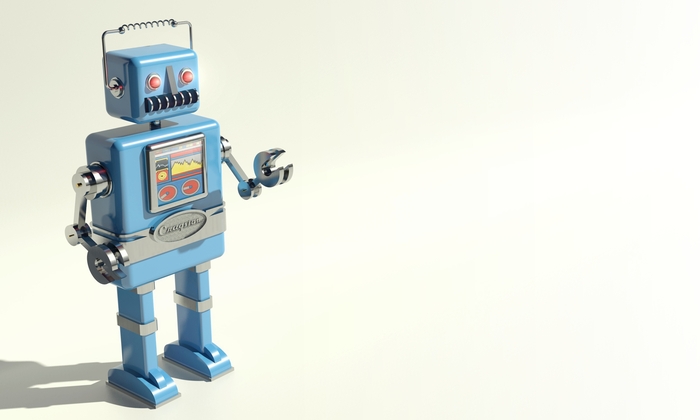
Source: Avero (CC-BY-NC-ND 3.0 License)
In contrast, over the last decade we have developed a rich imagery of robots. Some are critical and dystopian, but also relishing, funny and creative. Robots are a world cultural heritage and in our perception of robots, our expectation regarding the digital transformation finds expression.
Already in the Arabic Islamic Renaissance, people enjoyed humanoid machines. The Greek goddesses slipped into human bodies (Capurro, 2019). Karel Čapek is the inventor of the term “robot”. His creatures from the 1923 published theatre play, “R.U.R. – Rossum’s Universal Robots”, have more in common with a Roman army of removal men.
“In the prelude the robots are dressed like humans. They are scarce in movements and speech,expressionless faces, staring glare. In the actual drama they are wearing blue linenblouses, belt around the tail, and a brass number on the breast”.
Karel Čapek/R.U.R. – Rossum’s Universal Robots (1923)
Later the cyber-creatures became more funny, intellectual, cruel and technically advanced. Between Robocop and R2D2 we might not see a lot of technical progress but we do notice diametrically different ethical attitudes of their designers (and screenplay authors). The cyborg added a new model already expressing the vision of machines physically connected to our bodies.
Because of robots’ and cyborgs’ huge popularity, opportunities for education are opening up for coming into conversation with learners and the broader society on the aims, forms and ethical implications of machine ethics or (wo)men-machine ethics.Learning about and with robots as cultural and technical concepts could tackle the social visions regarding the digital transformation, and also help to enter into specific topics related to AI or automatisation. Also, the way in which robots are embedded in a cultural and social context could be explored – are they part of a dystopian or utopian society? A more creative approach to facilitate the topic could help us also in exploring and prototyping alternatives to existing narratives and constructions, exploring what kind of robot would be worth it to develop.
References: Capurro, Richard (2019). Ethical Issues of Humanoid-Human Interaction. Contribution to Guido Hermann and Ute Leonards (eds.). Humanoid-Human Interaction. In: Amarish Goswami and Prahlad Vadakkepat (eds.). Humanoid Robotics: A Reference. Springer: Dordrecht 2019, 2421-2435
Published in: Pirker, G. (2021). Culture, Art & Digitalisation. Digital Transformation in Learning for Active Citizenship. DARE Blue Lines, DARE – Democracy and Human Rights Education in Europe, Brussels, pp. 62